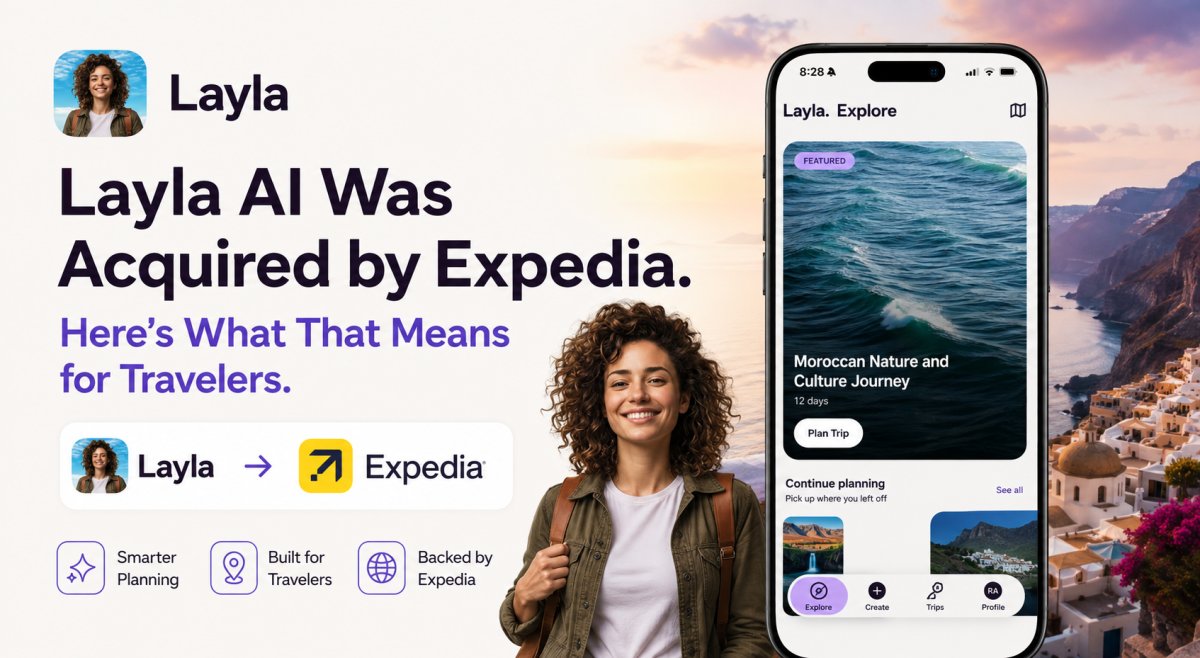
Layla AI Was Acquired by Expedia. Here's What That Means for Travelers.

Randy Allen
August 25, 2026 · 5 min read
Layla AI Was Acquired by Expedia. Here's What That Means for Travelers.
On July 31, 2026, Expedia Group announced it had acquired Layla, the Berlin-based AI trip planning startup founded in 2023 by Saad Saeed and Sardar Bali. The deal brings one of the more interesting independent AI travel planners into the fold of one of the world's largest online travel agencies — and it's worth understanding what that actually means if you use Layla, or if you're evaluating AI travel planning tools more broadly.
What Layla Was
Layla launched in 2023 with a clear goal: make trip planning feel like a conversation. The app let you describe where you wanted to go, what kind of trip you were after, and your budget, and it would assemble a personalized itinerary through a back-and-forth chat interface. It raised around €5 million across two funding rounds and built a team of roughly 25 people in Berlin.
The product was genuinely good at the conversational planning layer — moving users from "I want to go somewhere warm in November" through to a structured day-by-day itinerary with hotel suggestions, activities, and flights. It positioned itself as an AI travel agent rather than a traditional search-and-book tool.
What Expedia Is Getting
Expedia Group says the acquisition accelerates its AI strategy by combining Layla's advanced planning and personalization capabilities with Expedia's global supply, first-party traveler insights, marketplace scale, and booking technology.
That's the corporate framing. The practical translation: Expedia has been watching conversational AI eat into the traditional search-and-filter travel booking experience, and rather than build a competing product from scratch, they bought one that already works.
Expedia gains both technology and tech talent — the engineering team that built Layla's multi-agentic architecture, which is meaningfully different from simply bolting a chatbot onto an existing booking engine.
What This Means for Current Layla Users
The short answer is: not much changes immediately. Layla remains a standalone product for now, and its team will work alongside Expedia Group brands. If you're mid-planning on Layla, your trips are not going anywhere this week.
The longer answer is more complicated. When a large OTA acquires an independent AI tool, a few things tend to happen over time:
The product gets integrated into the parent's booking funnel. Expedia's stated goal is to wire Layla's planning capabilities into its inventory of flights, hotels, and activities. That means Layla's recommendations will increasingly surface Expedia Group inventory — Expedia.com, Hotels.com, Vrbo — rather than providing neutral suggestions across the full market.
The independent roadmap changes. Layla's founders built a product for travelers. Expedia will now prioritize features that serve Expedia's commercial interests, which aren't always the same thing. Features that drive bookings through Expedia's platform will get built. Features that don't, won't.
The team gets absorbed. Hiring additional tech talent will be a benefit of this deal regardless of whether the Layla platform exists as an independent entity a couple of years from now. That's an honest industry read — acquisitions of small AI startups by large platforms frequently result in the product being wound down once the team and technology have been integrated.
None of this is specific to Expedia or Layla. It's the standard acquisition trajectory. Layla users should enjoy the product as it currently exists and watch over the next 6-12 months to see how the integration changes it.
What It Signals About the Industry
The Layla acquisition is part of a broader pattern. The move makes Expedia both a platform and an AI native, which is a structural shift in its competitive position — and it comes alongside hotel chains like Radisson and IHG building their own conversational AI booking interfaces. Every major player in the travel industry is racing to own the AI planning layer.
The concern for travelers is straightforward: as AI trip planning tools get acquired by OTAs, airlines, and hotel chains, the recommendations they generate will increasingly reflect the commercial interests of whoever owns them. An AI trip planner owned by Expedia will naturally tend to suggest Expedia inventory. One owned by a hotel chain will tend to suggest that chain's properties.
This is why independent AI travel planners — tools that have no booking inventory to push — matter. When an AI assistant's only job is to help you plan the best possible trip rather than route you toward a specific platform's inventory, the recommendations stay genuinely neutral.
Where Ribbit Fits
Ribbit is an independent AI trip planner. We don't sell flights, hotels, or activities directly. Our AI assistant Lily's job is to build you the best possible itinerary for wherever you're going — not to route you toward a specific booking platform.
We do integrate with Viator for activity bookings and scan your Gmail for booking confirmations automatically. But the planning itself is neutral. Lily suggests what to do, where to eat, and how to structure your days based on what makes the most sense for your trip — not based on what earns us a commission.
That's not a knock on Expedia or Layla. It's just a different approach, and one worth understanding as the industry consolidates around large platform ownership of AI planning tools.
If you want to try it, Ribbit is free to download on iOS and Android. Ask Lily where you want to go and she'll have a full itinerary ready in seconds.
The Bottom Line
The Layla acquisition is good for Expedia. It's probably fine for current Layla users in the short term. Over the longer term, it's one more independent AI travel planning tool moving inside a large commercial platform.
For travelers who want planning advice that isn't shaped by a booking platform's inventory, the options are getting fewer — which makes the ones that remain worth knowing about.