Guide to the 2026 FIFA World Cup Host Cities: Where to Stay, Eat, and Explore

Randy Allen
June 9, 2026 · 15 min read
Guide to the 2026 FIFA World Cup Host Cities: Where to Stay, Eat, and Explore
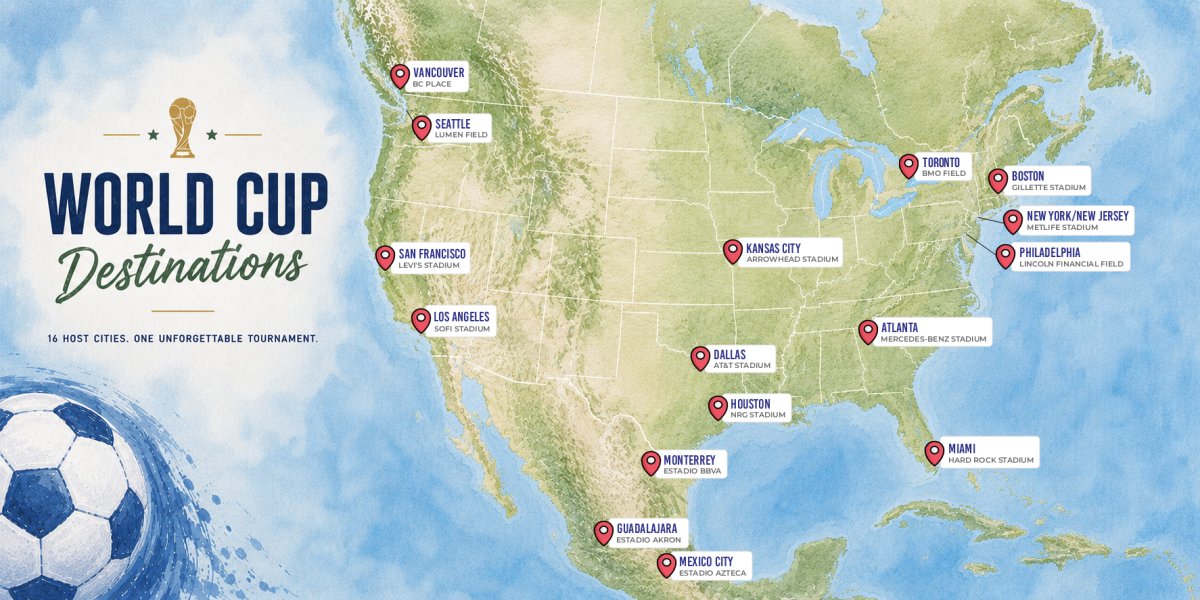
The 2026 FIFA World Cup is the biggest sporting event in a generation: 48 teams, 104 matches, and three countries hosting what will almost certainly be the most attended World Cup in history. If you've got tickets, you're traveling to one of 16 host cities across the United States, Mexico, and Canada between June 11 and July 19. And if you're anything like most fans, you've sorted the match tickets but haven't thought much about everything else.
That's where this guide comes in. Here's what to know about each host city, where to base yourself, what to eat, and what to do when you're not in the stadium.
United States
New York / New Jersey
MetLife Stadium in East Rutherford hosts the final on July 19, making New York the centerpiece of the entire tournament. Stay in Manhattan if budget allows. For the stadium, NJ Transit from Penn Station is your best bet. Between matches, the obvious hits are worth it: walk the High Line, grab a slice in Brooklyn, eat your way through Koreatown on 32nd Street. If you want something less touristy, spend a morning in Flushing for some of the best and most authentic food in the entire city.
Metlife Stadium
Penn Station
The High Line
 Plan your New York World Cup trip with Lily.
Los Angeles
SoFi Stadium in Inglewood hosts the US men's national team's opening match on June 12 and several knockout round games. LA is massive and spread out, so where you stay matters more here than anywhere else. If you're going to the stadium, base yourself in Inglewood, El Segundo, or Manhattan Beach to avoid the freeway. Between matches: the Getty Museum, a morning in Silver Lake, tacos from a strip mall in East LA, and at least one afternoon in Santa Monica. Rent a car or you'll spend half your trip in an Uber.
SoFi Stadium
The Getty
Silver Lake
Dallas
AT&T Stadium in Arlington hosts a semifinal on July 14 alongside multiple group stage and knockout matches. Dallas is more walkable than its reputation suggests. Deep Ellum is worth a night out, and the Perot Museum of Nature and Science is genuinely excellent. For food, hit one of the legendary Texas BBQ spots: Pecan Lodge or Terry Black's are the standards. In July, it will be extremely hot, so plan accordingly.
AT&T Stadium
Deep Ellum
Perot Museum of Nature and Science
Pecan Lodge
Terry Black's Barbecue
Atlanta
Mercedes-Benz Stadium hosts a semifinal and multiple knockout games and is one of the most architecturally striking venues in American sports. Between matches, explore the BeltLine, which connects neighborhoods via walking and cycling trails through converted railway corridors. Ponce City Market is a great half-day. Atlanta's restaurant scene is genuinely underrated. Try Staplehouse or Lazy Betty for something memorable. Summers in Atlanta are hot and humid, so factor that into your planning.
Mercedes-Benz Stadium
Atlanta Beltline
Ponce City Market
Staplehouse
Lazy Betty
Miami
Hard Rock Stadium hosts group stage and knockout matches. Miami is one of the most naturally suited World Cup cities on the list: international crowd, warm weather, beach access, and a food scene that skews heavily toward Latin American cuisine. Stay in Miami Beach or Brickell. Wynwood is worth an afternoon for the street art and galleries. Little Havana for Cuban food. South Beach for everything else.
Hard Rock Stadium
Miami Beach
Brickell
Wynwood
Little Havana
South Beach
Houston
NRG Stadium hosts seven matches including a July 4th game that will make for an electric atmosphere inside the stadium. Houston is the most underrated food city in the United States. The combination of Vietnamese, Tex-Mex, and Southern food in one city is unmatched. Spend time in the Montrose neighborhood, visit the Menil Collection (free and world-class), and eat as much as you possibly can. The weather in July is brutal. NRG Stadium is fully air-conditioned, but plan for the heat outside it.
NRG Stadium
Montrose
The Menil Collection
Seattle
Lumen Field hosts group stage and knockout matches. Seattle is the most naturally beautiful of all the US host cities, surrounded by mountains and water. Between matches, take the ferry to Bainbridge Island, walk through Pike Place Market early in the morning before the crowds, and hike to one of the viewpoints in Discovery Park. For food, the seafood is exceptional. Seattle in June and early July has genuinely stunning weather, which makes it the most pleasant US host city to spend time in. Worth noting: Vancouver is only a three-hour drive north, making a combined trip across both cities very doable.
Lumen Field
Bainbridge Island
Pike Place Market
Discovery Park
Boston
Gillette Stadium in Foxborough hosts group stage and a quarterfinal. Boston is compact and extremely walkable. The Freedom Trail is worth doing once. For food, get a lobster roll from Neptune Oyster or James Hook and don't overthink it. The North End for Italian. The South End for cocktails. Boston fans are intense about their sports, which will make the atmosphere around World Cup matches particularly electric.
Gillette Stadium
Freedom Trail
Neptune Oyster
James Hook & Co
North End
South End
Philadelphia
Lincoln Financial Field hosts group stage and knockout matches. Philadelphia has one of the most passionate soccer supporter cultures in the United States, thanks largely to the Philadelphia Union and their famously loud supporters section. The city is walkable, relatively affordable compared to New York, and has an underrated food scene centered around Reading Terminal Market. Eastern State Penitentiary is one of the more genuinely interesting tourist experiences in the country. And yes, a cheesesteak. Jim's on South Street is arguably better than the famous ones.
Lincoln Financial Field
Reading Terminal Market
Eastern State Penitentiary
Jim's South St.
San Francisco Bay Area
Levi's Stadium in Santa Clara hosts group stage and knockout matches. The Bay Area is logistically complex to navigate since the stadium is in the South Bay while most of what you'd want to see is in San Francisco or Oakland. That said, it's one of the most spectacular settings on the list. Spend a morning on the Embarcadero, cross the Golden Gate on foot or by bike, eat at the Ferry Building Marketplace, and take a day trip to Muir Woods if the itinerary allows. June weather in SF is famously cold and foggy, so pack a layer even if you're arriving from somewhere warm.
Levi's Stadium
Embarcadero
Golden Gate Bridge
Ferry Plaza Farmers Market
Muir Woods National Monument
Kansas City
Arrowhead Stadium hosts group stage and knockout matches. Kansas City is the surprise entry on this list for many international visitors and turns out to be one of the most welcoming cities in the country. The barbecue is the main event. Joe's Kansas City (in a gas station, improbably) and Q39 are the standards. The 18th and Vine Jazz District is a legitimate piece of American musical history. The Nelson-Atkins Museum of Art is free and world-class. Kansas City in July is hot and humid, but the city genuinely punches above its weight as a host.
Arrowhead Stadium
Joe's KC BBQ
Q39 - Midtown
18th And Vine
The Nelson-Atkins Museum of Art
Mexico
Mexico City
Estadio Azteca hosts the tournament's opening match on June 11, making Mexico City the place where it all begins. The stadium is one of the most historic in world football, having hosted two previous World Cup finals. The city itself is enormous, fascinating, and deeply rewarding to explore. Stay in Roma or Condesa for the best access to cafes, restaurants, and nightlife. The Frida Kahlo Museum in Coyoacán is worth the trip. The Teotihuacan Pyramids are an easy day trip. Mexico City's metro system is affordable and extensive, so getting around is straightforward once you get the hang of it.
Estadio Azteca
Roma
La Condesa
Frida Kahlo Museum
San Juan Teotihuacán
Guadalajara
Estadio Akron hosts group stage matches starting June 11. Guadalajara is widely considered the cultural heart of Mexico: home of mariachi, tequila, and a thriving arts scene rooted in colonial architecture and muralism. The Guadalajara Cathedral and Instituto Cultural Cabañas are the obvious starting points. For food, Mercado San Juan de Dios is a great introduction to local flavors. The Chapultepec district has excellent bars and live music. And if you have a free day, the town of Tequila is about an hour away and offers distillery tours that are genuinely worth the trip.
Estadio Akron
Guadalajara's Cathedral
Cabañas Museum
Mercado San Juan de Dios
Monterrey
Estadio BBVA hosts four matches starting June 14 and is one of the more spectacular stadium settings in the tournament, with views of the Cerro de la Silla mountain from the stands. The city sits in a natural bowl surrounded by mountains, which makes it excellent for hiking and outdoor activities between games. For a more urban experience, the Barrio Antiguo Quarter is the neighborhood to base yourself in, with boutique hotels, restaurants, and a lively nightlife scene. The Macroplaza and the city's riverwalk are both worth an afternoon. Monterrey is geographically closer to Houston than to Mexico City, which makes a cross-border trip between the two cities a realistic option for fans.
Estadio BBVA
Barrio Antiguo
Macroplaza
Canada
Toronto
BMO Field hosts group stage matches starting June 12 as Canada plays its opening games on home soil. Toronto is one of the most multicultural cities in the world and that shows in the food scene, which covers virtually every cuisine at every price point. The Distillery District is worth an afternoon. Kensington Market for a more local feel. The Art Gallery of Ontario is genuinely excellent. CN Tower if you haven't been. Toronto's transit system is reliable enough to get you from the downtown core to the stadium without much hassle. The city is also hosting one of the tournament's Fan Festivals, so expect a lively atmosphere well beyond matchday.
BMO Field
Distillery District
Kensington Market
Art Gallery of Ontario
CN Tower
Vancouver
BC Place hosts group stage matches starting June 13. Vancouver is consistently ranked among the most livable and beautiful cities in the world, and it earns that reputation. Stanley Park alone is worth a full day. Granville Island for food markets and local craft. Gastown for the historic neighborhood feel. If you have more time, Whistler is about two hours north and stunning in summer. Vancouver is also hosting a major Fan Festival at Hastings Park with a large screen showing every game. The city is a three-hour drive from Seattle, so a combined trip visiting both host cities is one of the better itineraries of the entire tournament.
BC Place
Stanley Park
Granville Island
Gastown
Whistler
Hastings Park
Plan your World Cup trip with Ribbit
Whichever city you're headed to, Ribbit can build you a complete day-by-day itinerary in seconds: matches, restaurants, things to do, and anywhere you want to explore between games. Tell our AI assistant Lily where you're going and she'll handle the planning.